

Kåre Conradi conveys complexity with ease.
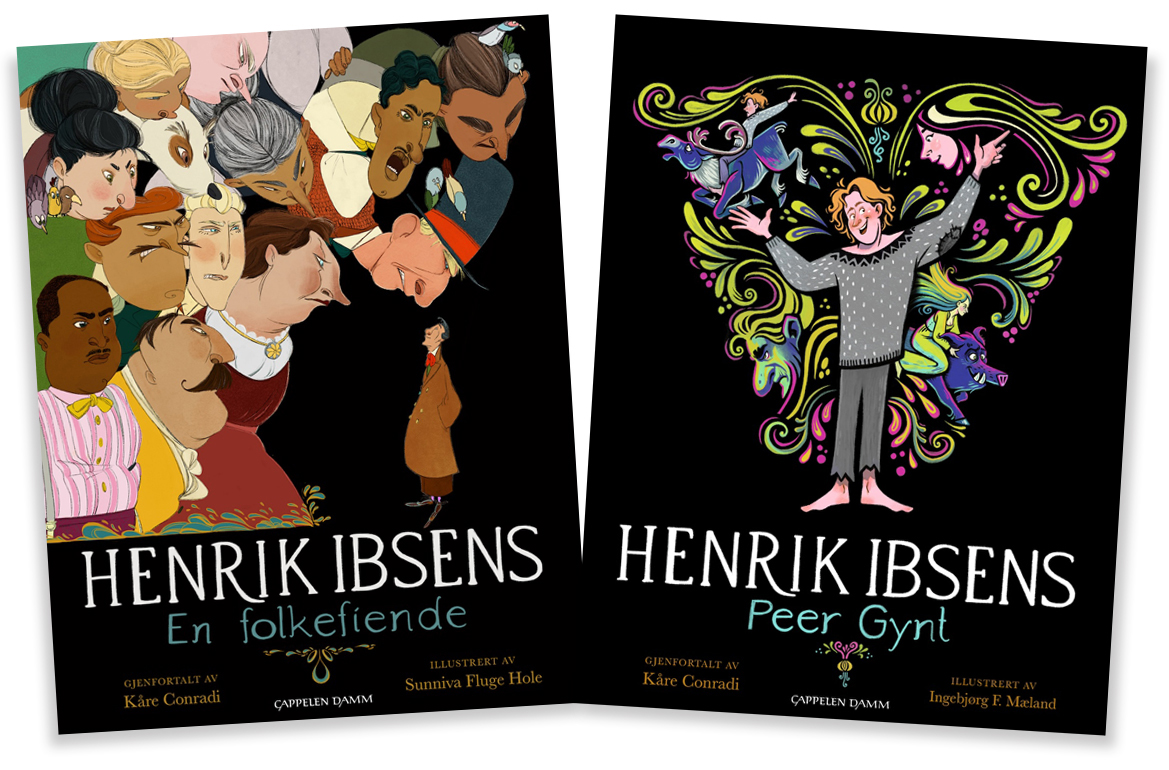
The books Henrik Ibsen’s Peer Gynt and Henrik Ibsen’s An Enemy of the People are straightforward retellings for children of the two well-known plays written in 1867 and 1882 respectively. The plots of the two works differ greatly, yet both dramas can be said to be just as relevant today as they were in their own time. Creating drama with a timeless relevance was Ibsen in a nutshell, and Kåre Conradi exploits this potential brilliantly. With valuable assistance from illustrators Ingebjørg F. Meland and Sunniva Fluge Hole, he has modernized and simplified the plays into vivid and engaging children’s literature.

Peer Gynt in the Age of Self-Assertion
In Peer Gynt we follow the life of the title character, Peer—a notorious daydreamer and egocentric who sets out on adventures to find himself and his place in the world. He oscillates between extremes and repeatedly runs into his own contradictions. One moment he is a king, the next a complete failure. He is confronted with his own weaknesses, yet adopts the motto “go around it” as his life strategy.
The world-famous play—and its retelling—can be interpreted on several levels, both as pure entertainment and as a philosophical provocation. The moral lies between the lines, as a reminder of the old proverb “pride comes before a fall.” The play from 1867 is not only timeless but strikingly relevant in our self-assertive age. How does one preserve the self in the jungle of social media, selfies, influencers, and cosmetic surgery? Or, as the Button Moulder replies in Conradi’s version when Peer asks what it means to be oneself:
“You can only be yourself when you stop thinking about yourself all the time.”
Bringing Peer Gynt to a younger audience thus seems highly relevant. Conradi has modernized the language into a recognizable narrative, making the message clearer and more accessible.
The famous onion scene is a good example of this approach. Unlike Ibsen’s original manuscript, Conradi gets straight to the point in his retelling. The scene almost takes on a meta-function, as the text is peeled away in parallel with the onion. Yet unlike Peer, who never reaches the core, Conradi manages to preserve the essence of this important scene. This becomes clear when comparing the retelling with the original text.
Peer spots an onion lying on the ground and, for fun, begins peeling it layer by layer.
“You are an onion,” he says to himself. “Now I will peel you layer by layer to see what you are made of deep inside!”
With each layer he peels away, he is reminded of something he has experienced in life.
The first, worn layer reminds him of the shipwreck at sea.
The next, juicier layer of his time as a prophet.
The next, thin layer reminds him of his time as a merchant.
But Peer keeps peeling, for he wants to reach the core. Yet… with every layer he removes, he only comes to another layer.
“All the way to the innermost core, it’s nothing but layers!” Peer gasps. “There is no core!”
(From Henrik Ibsen’s Peer Gynt, retold by Kåre Conradi)
(Original excerpt omitted for brevity in translation context)
Simplification at the Expense of Depth
Tampering with Henrik Ibsen himself is a rather daring undertaking—especially with such an iconic play as Peer Gynt. As we see from the original text, it is significantly more nuanced than Conradi’s retelling. The psychological depth that characterizes Ibsen is somewhat toned down in Conradi’s version. On the other hand, the two versions operate within different literary genres—one as a theatrical play, the other as a children’s story. This fundamental difference also legitimizes the liberties Conradi has taken.
He conveys a condensed version of the plot that presents the message in an unpretentious manner. His aptitude for this approach is likely connected to his background as both an established actor and the artistic director of The Norwegian Ibsen Company, which he founded in 2012. In both books, it is evident that he has Ibsen “in his spine.” Precisely for this reason, he succeeds in conveying complexity with ease and is thus well equipped to reach and engage children through these retellings.
An Enemy of the People in the Age of Cancellation
An Enemy of the People revolves around Doctor Tomas Stockmann, who discovers that the water in the local baths is contaminated. He wants to make this public to protect the health of the townspeople—people could die if they drink the water or bathe in it. At first, he is hailed as a hero of the people, but once the inhabitants realize this will cost them money, everyone turns against him. Opposition comes from all sides, yet Stockmann chooses to stand firm and becomes a champion of truth.
In his retelling of An Enemy of the People, Kåre Conradi applies the same approach as in Peer Gynt. The language is modernized and the plot reduced to its cardinal point: the conflict between truth and self-interest. Dr. Stockmann fights for the individual’s right to freedom of expression in a small community, where the antagonist is embodied by herd mentality, cowardice, and egoism. The protagonist, however, is accused of being the enemy of the people himself when he insists that the uncomfortable truth must come out. He and his family are ostracized, yet he remains unshaken in his conviction and refuses to be rattled.
An Enemy of the People appears just as relevant as Peer Gynt in light of today’s polarized society. The conflicts between environmental protection and capitalism, freedom of speech and cancel culture, are creating ever deeper divisions among the population. Advocating the truth and standing up against the majority involves greater risk today than it did ten years ago. In extreme cases, it can cost one’s job, position, family, and friends. Both Ibsen’s original play and Conradi’s retelling serve as important reminders of herd mentality, online harassment, and social exclusion.
Theatrical and Original Aesthetics
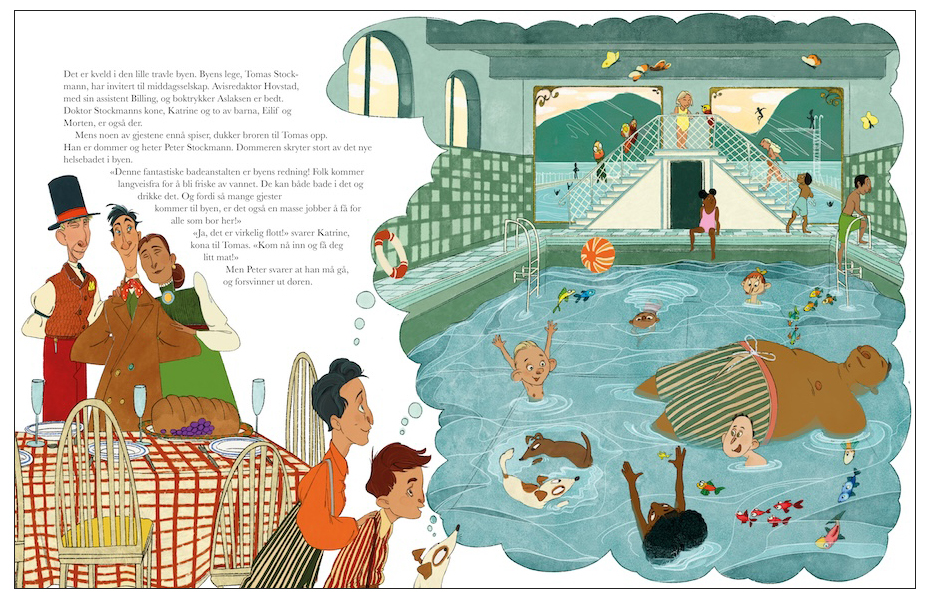
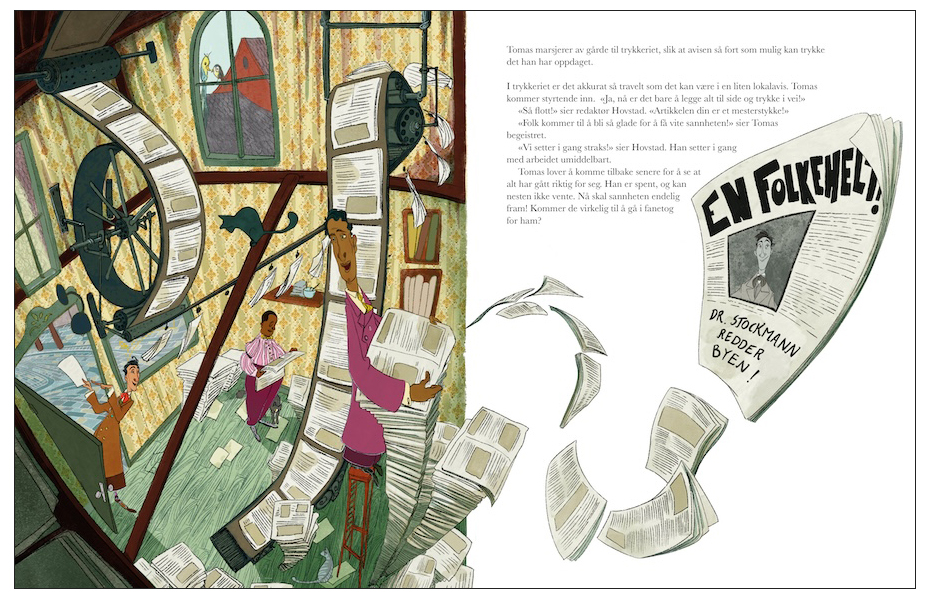
Both books are adorned with beautiful illustrations that make an important contribution to the reading experience. In An Enemy of the People, we encounter the entire cast of characters already on the inside cover, where each figure is presented in a caricatured and theatrical manner. Particularly noteworthy is Dr. Stockmann’s father-in-law, depicted as a stiff eccentric in a long coat with a head seemingly detached from his body.
The small portrait on the title page of Henrik Ibsen—with his broad body and long feet—also possesses a delightful originality. Illustrator Sunniva Fluge Hole maintains the theatrical tone throughout the book, where each page appears as a stage scene rendered with a lively and humorous hand. Cityscapes, situations, and interiors are inviting and richly detailed. One can spot references to The Ridiculous Families, Disney, and Carl Larsson, to name a few associations. The nostalgic aesthetic works excellently with the text.
Fantasy Style with Folkloristic Undertones
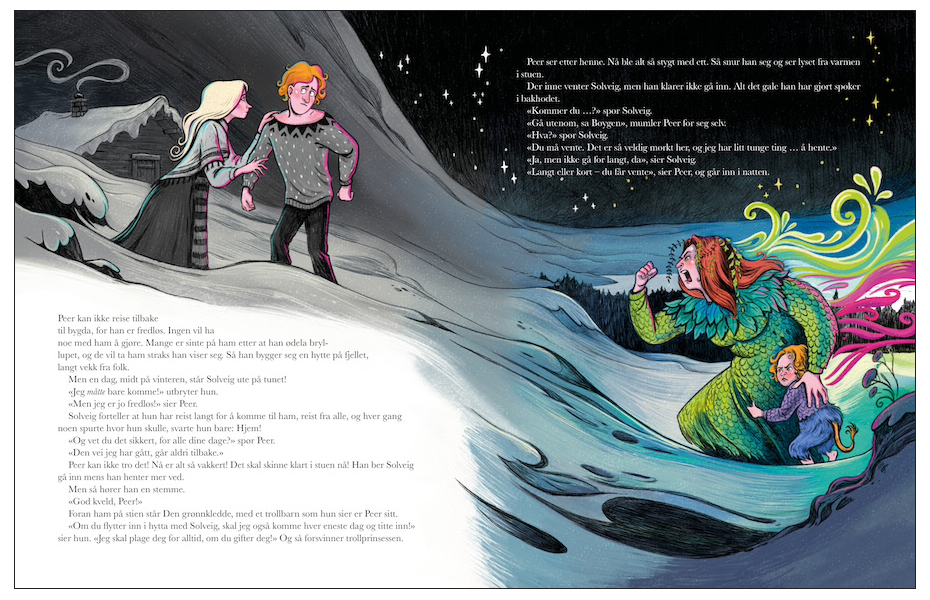
Ingebjørg Faugstad Mæland’s illustrations in Peer Gynt differ greatly from Hole’s visual approach. Both books open with a portrait of Ibsen, but Mæland’s version is less caricatured than Hole’s. In return, the portrait is a striking visual hook and the first thing we encounter in the book: a fully formed Ibsen in coat and umbrella against a bright pink background.
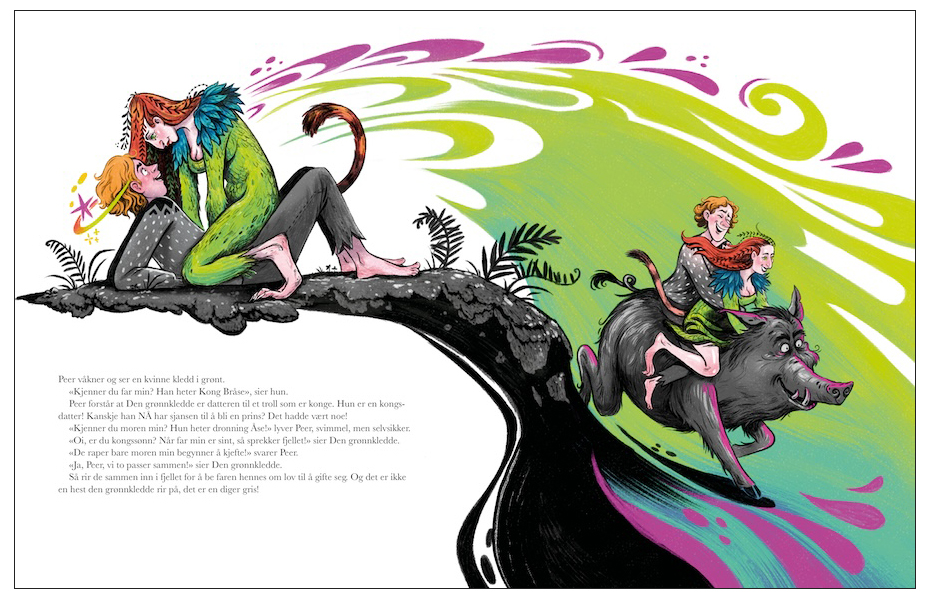
Beyond this, the illustration style appears as a cross between fantasy and old folk tales—a fitting approach to Peer Gynt, which is far more imaginative than the reality-based An Enemy of the People. Mæland reinforces the illusory atmosphere with ornamental and folkloristic elements. This works particularly well on the book cover, where Peer is surrounded by subtle fragments of the story, shaped as elegant decorative forms.
The scene where Peer bids farewell to his mother Åse midway through the book also deserves special mention. We see a fragment of Peer mourning his deceased mother in bed. On the left side of the sky, he follows her by horse and sleigh up toward the stars. On the right side of the sky, we see Mother Åse being received by an angel. Both fragments are framed by folkloristic patterns against a pitch-black night sky. This scene represents the visual high point of Conradi’s Peer Gynt, where images and text complement each other exquisitely.